Ask the Architect: Dr. John Greenwood OBE Back in Hong Kong
Last month, Chartwell Institute was delighted to welcome our Senior Advisor, Dr. John Greenwood OBE, back to Hong Kong. Dr. Greenwood is widely known as the architect of the Hong Kong dollar peg, the Linked Exchange Rate System introduced in 1983 that has tied the Hong Kong dollar to the US dollar for more than four decades.
An evening with friends of the Institute
During his visit, we hosted a dinner in Dr. Greenwood's honor, bringing together guests and friends of the Institute for an evening of conversation on Hong Kong's monetary system, the global economy, and the city's role as an international financial center.

Dr. John Greenwood OBE delivers a presentation on the dollar peg and takes audience questions at the dinner.
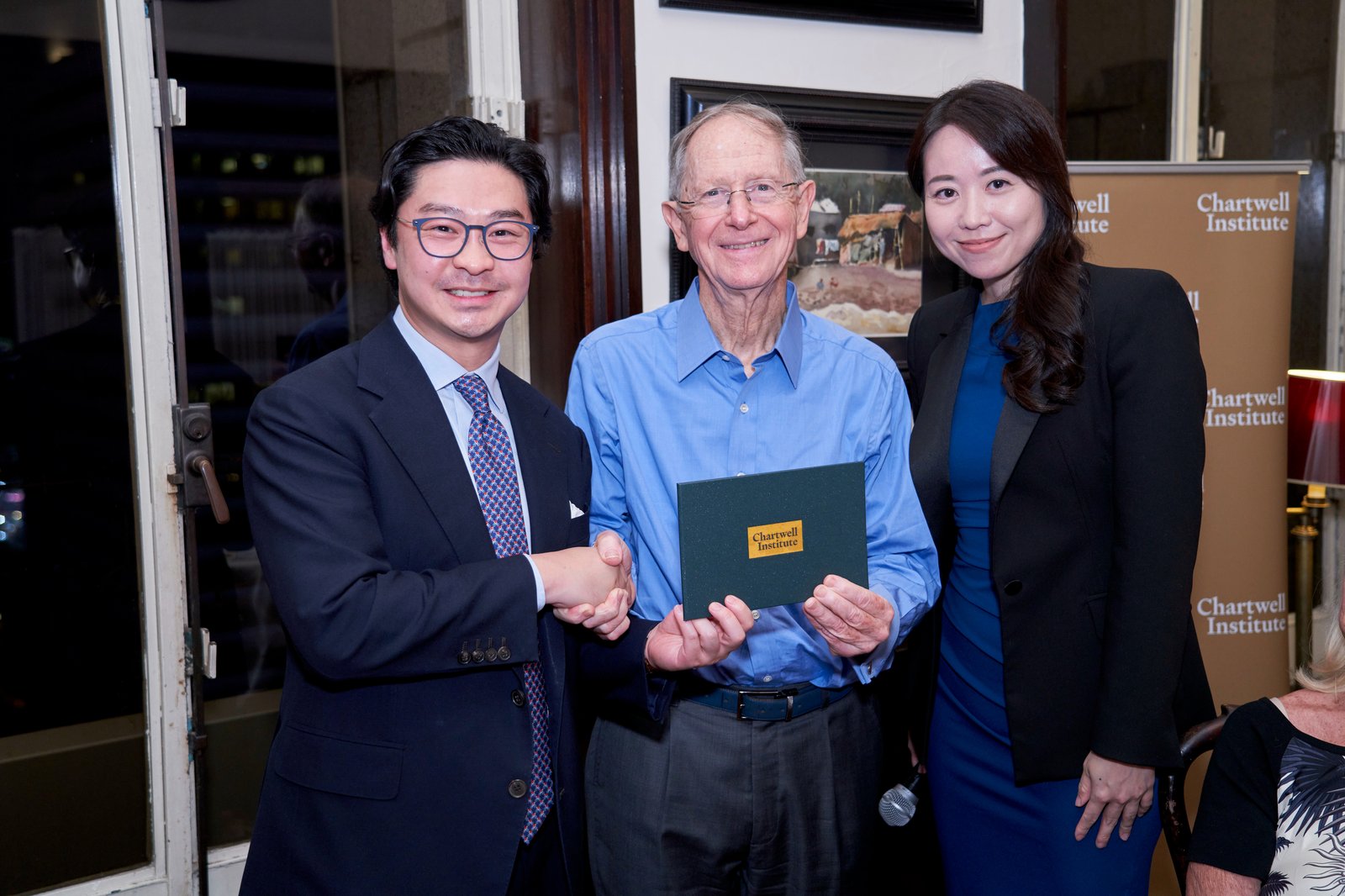
Dr. John Greenwood OBE with Chartwell Institute co-founders Ronald Chan and Kylie Wong.
Ask the Architect: three questions on the peg
This is not the first time we have worked with Dr. Greenwood to explain the peg to a wider audience. Previously, we produced an animated video with him explaining why the Hong Kong dollar peg had to be put in place.
This time, we sat down with Dr. Greenwood to record three short videos in our new Ask the Architect series. In the first, he explains in brief how the peg actually works. In the other two, he takes on questions we often hear: whether the renminbi could replace the US dollar in the peg, and what would happen if the United States no longer wanted Hong Kong pegged to the dollar.
The videos and their transcripts are below. Transcripts have been lightly edited for readability.
1. How does the peg actually work?
Dr. Greenwood explains that the Hong Kong dollar works because it can always be converted into US dollars at a fixed rate, both for banknotes and in the wholesale foreign exchange market, and why the system is so hard to break.
Dr. Greenwood: The Hong Kong dollar works because it is convertible at a fixed rate into US dollars. And this happens at two levels. First, what we might call the retail level, where banknotes are exchanged for a fixed price with US dollars. And then secondly, at the wholesale level, which is in the foreign exchange markets, where traders and banks exchange Hong Kong dollars primarily for US dollars, but also other currencies. And those prices are contained within a range that is set by some convertibility undertakings: promises by the government to exchange currency always within those limits. It's basically a convertibility system that does not require intervention.
It wouldn't be easy to break it at all, because all the Hong Kong dollars that have been issued are backed up by US dollars held by the Hong Kong Monetary Authority. And these can always be provided, returned to the market, for people who want to cash in Hong Kong dollars. That's at what I call the retail level, for banknotes, at the fixed rate of 7.8.
But then at the wholesale level, equally, it would not be easy to break it. Because you would have to sell Hong Kong dollars in very, very large volumes, in such a way that would make interest rates rise to levels which are impossible to operate; just create such a shortage of Hong Kong dollars that the system would kind of come to a halt. But the government is always willing to provide US dollars to sellers. Again, it has very large reserves to do that. And so the availability from the government of foreign currency to meet the demand for disposal of Hong Kong dollars is so large that the system cannot be broken. There's really no time at which pressure comes on the market when the government can't act. It can always act to provide foreign currency, because it has very large reserves.
2. Hong Kong is promoting wider use of the renminbi. Is it on track to replace the US dollar in the peg?
A growing offshore renminbi market would be good for Hong Kong, says Dr. Greenwood, but the Hong Kong dollar will remain the city's currency, and the government is not thinking of moving away from the peg.
Dr. Greenwood: But in principle, most of the transactions in Hong Kong are going to continue to be in Hong Kong dollars. So the Hong Kong dollar will continue to be the currency of Hong Kong.
The renminbi settlement market is a market for offshore renminbi, renminbi which are outside China, sometimes called CNH, Chinese yuan in Hong Kong. If that market was to develop, I think that would be advantageous to Hong Kong. But the government is not in any way thinking of moving away from the Hong Kong dollar peg. For one thing, it says in the Basic Law that the Hong Kong dollar will be the currency of Hong Kong.
3. What if the US no longer wants Hong Kong pegged to the dollar?
Dr. Greenwood argues that dollar pegs benefit the United States, through interest earnings, seigniorage, the dollar's strategic role, and the business of US banks, which is why the idea did not go anywhere when it was floated during the first Trump administration.
Dr. Greenwood: They could say that. And on one occasion, during the first Trump administration, there was some rumor that they might do that. But in fact, when they thought about it, it turned out to be very advantageous to the US to have other currencies pegged to the US dollar. Because it means that the US can earn interest, and what we call seigniorage, the profits from issuing money, by allowing other countries to peg their currency to the US dollar.
So in the case of Hong Kong, the Hong Kong government holds a large amount of US dollars, and that means that the US is always a recipient of those funds, and that stock of money isn't going to go away. There's always a demand to hold US dollars by foreign holders of currencies that are pegged to the US dollar. So it's advantageous to the US to maintain the system.
I don't think it's ever going to be likely that the US would say to a country, "[Don't] peg to the US dollar." Apart from anything else, fixing a currency to the US dollar enhances the importance and the strategic role of the US dollar in a way which would not occur if the currency was freely floating.
During the first Trump administration, when they really did consider denying the right of foreign currencies to peg to the US dollar, first of all, they understood or realized that they couldn't stop anybody from pegging to the US dollar. And secondly, they realized that many banks, US banks, benefited from the system. We have a lot of US banks here in Hong Kong, and if you stop them from operating from Hong Kong, their business, which is mainly with the US, would be terminated. That's not good for US business. It's not good for the US. So it's not something which is going to happen. It was a short-sighted and short-lived policy.
We thank Dr. Greenwood for his time and insight, and look forward to welcoming him back to Hong Kong again soon.